
TOPICS OF CONFERENCES:
1. Knowing Portugal, its people and the greatest business opportunities
This 30 minutes talk covers two topics:
1 — The Portuguese culture and the historical events that shaped it, the characteristics and peculiarities of its people; and
2 — Where lie the greatest business opportunities for your company.
The latter is tailor made for each client, depending both on its sectors of activity and Portuguese imports. The opportunities are detailed at four digits code of the Eurostat and defined in potential sales value (euros).
Thus, a conference dedicated to know who/how your Portuguese hosts are and where they come from, as well as becoming aware of the greatest business opportunities for your company before you leave Portugal.
2. Nothing changes: Drucker’s questions to create competitive organizations are eternal
An extension of the TED talk (link: https://youtu.be/SOkjPv1lFts): in a constantly changing world great questions remain as actual as ever: who is the client, where is the client, what is value (and equally important, non-value) for the client, what are the client’s unsatisfied needs, if we were to decide today would I enter the same businesses I am in and if not what am I going to do about that, etc.
Good questions remain. Only the answers change with time. Thus a good question is half an answer (Francis Bacon) and a man should be judged by his questions, not by his answers (Voltaire).

Link for the TED USA conference on this topic: https://youtu.be/SOkjPv1lFts
3. Peter Drucker on how do I want to be remembered? How can I make a difference?
Many motivational talks focus on examples of who plunged to the greatest depths of the oceans, conquered the thickest forests, or climbed the highest mountains.
This conference centers on the management tools which enable us to make a difference and thus leave a legacy to be remembered for.
Those instruments are simple. Within anyone’s grasp. And through a common link directly impacting on the multitude of today’s problems: from population growth to poverty.
Regardless of how insignificant a job (seems) to be. And according to Peter Drucker, the founder of modern management.
4. Peter Drucker on corporate strategy
How multibusiness organizations go about defining their strategy (11 steps) in order to create synergy (rather than anergy).
Based on:

5. Philip Kotler on business strategy for brand/product managers
The 14 strategic moves (6 of attack and 8 of defense) and how to implement them; one can win with ten and loose with one hundred (P. Kotler).
Based on:

6. Peter Drucker on staffing: putting the right person in the right place and building great teams
Staffing: how to build great teams by:
- Forgetting weaknesses and focusing on strengths;
- Ignoring human relations/teambuilding and concentrating on the key factors of the jobs to be done; and
- Rather than knowledge focusing on the required temperament: most business functions accept a second rate intellect but require a first rate temperament (P. Drucker)
Based on:
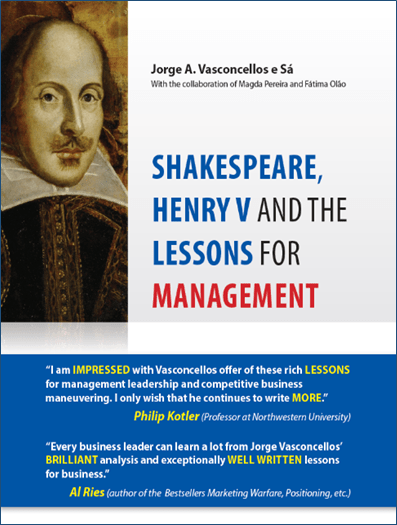
7. Peter Drucker on effective leadership: what really matters:
Leadership is as popular as a placid subject.
However the examples of Katharine Graham (a housewife heir to the Washington Post), or of Darwin Smith (a discreet lawyer who as CEO transformed Kimberly-Clark into one of the most admired world companies), demonstrate how what truly matters for effective leadership is frequently plainly missed.
Only two behavioural traits (not personality types much less charisma) and also two management skills, are absolutely necessary conditions for great leaders.
That is the message of Peter Drucker, the founder of modern management.
Based on:
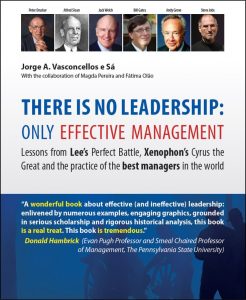
8. Peter Drucker on how to manage clients and make (the five sections of) a marketing plan
The purpose of a business is to create a customer (P. Drucker).
Based on:
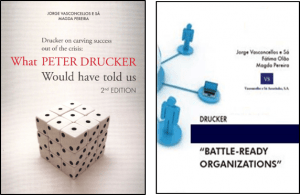
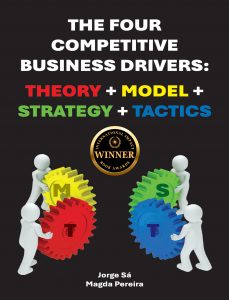
9. The Four Competitive Business Drivers: 1) theory of business, 2) business model, 3) strategy and 4) tactics (based on the award-winning book published in January 2026 by Business Expert Press, New York)
Organizational competitiveness requires excellence in four drivers:
– The theory of business: why, the organization makes sense; the reality assumptions it is grounded upon;
– The business model: the what, the basic cornerstones of its functioning: how it transforms clients satisfaction into profits;
– Strategy: the where it operates in terms of geographical areas plus industries plus segments (within the industries); and
– Tactics: the how of the nine functional areas, from marketing to human resources management, to finance, production, accounting, administration (maintenance, security, etc.), R&D, information systems and general management (organization chart, control and coordination): how to advertise, how to motivate, how to finance operations; how to etc.
These four drivers are: 1) distinct; 2) interrelated (some impacting but not totally pre-defining the others); 3) must produce a coherent/compatible mix (must fit together); 4) have to be periodically updated; and that (5) following pre-set steps in order to facilitate such a task.
This is illustrated by detailed examples of e.g. Nike, Dollar Shave Club, Spotify, SpaceX, Vendôme, Sears, IBM, Apple Music, McDonald’s, Marks & Spencer, Canva, SolarCity, Farfetch, etc.
The fundamental message is that neglect of any of the four drivers brings efficiency (doing things right – the Phronesis of Aristotle) at the cost of lower effectiveness (doing the right things – the Chokhmah of Solomon).
With more and more resources producing less and less, underperformance will follow.
Based on the book by J. Sá: “The Four Competitive Business Drivers: Theory, Model, Strategy, Tactics”, published by Business Expert Press of New York in January 2026.
This book was the winner of the “International Impact Book Awards 2026”.
Based on:
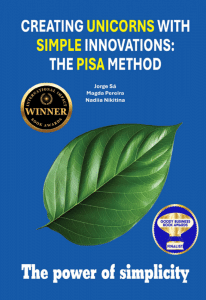
10. Creating unicorns with simple innovations: the PISA method (based on the award-winning book published in May 2025 by Business Expert Press of New York)
The glamour of technical sophistication has overshadowed a present second major source of high value innovations: simplicity.
In the past when life was plainer and its pace smoother, simplicity was not so much valued. Today it is the source of innumerous unicorns. But simple innovations does not mean that they are easy. And therefore a process is necessary and that is what the five-step PISA method does:
- 1st: Focusing on simplicity (which as said is the ultimate sophistication);
- 2nd: Opportunities that come to us (instead of having actively to look for them);
- 3rd: Adapting solutions already in use elsewhere (rather than constructing them anew);
- 4th: Testing consumers’ actions and emotions (in lieu of words or thoughts); and finally
- 5th: Entering the market in a nonexpensive way and with minimal risk.
Based on the book by J. Sá: “Creating Unicorns With Simple Innovations: the PISA method”, published by Business Expert Press of New York in May 2025
This book was the winner of the “International Impact Book Awards 2025” and finalist of the “Goody Business Book Awards 2025”.
Based on:
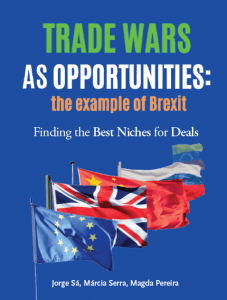
11. Trade Wars as Opportunities: Finding the Best Niches for Deals
Trade sanctions are an increasingly common weapon. Against Russia, China, Venezuela, Iran, Turkey. In top of trade disruptions such as Brexit, US Exit, etc. And all of them constitute great opportunities, disguised as risks, provided the use of the proper methodology.
This conference provides such a simple and highly effective tool to be equally used by companies, industrial associations or even countries.
The output, is always the same: a shortlist of the best business niches and the name of the main clients to focus on among thousands of alternatives. And where each opportunity niche represents hundreds of times a company’s present turnover.
This conference is thus useful to whom wants to take advantage of trade wars. Recalling Machiavelli recommendation of: never to waste the opportunities created by a good crisis.
Based on:
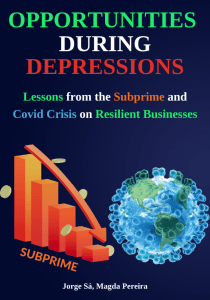
12. Opportunities During Depressions – Lessons from the Subprime and Covid crisis on resilient businesses
Which among the 615 segments in the economy accelerate their growth during any type of crisis? (subprime, Covid, Ukraine war, etc.).
This conference provides managers with examples and a methodology to find resilient businesses during economic crisis. Whatever their cause.
During both the subprime and Covid crisis there were some highly resilient businesses: while some kept on growing, others even accelerated their growth. Thus within any industry there are some activities which constitute safe heavens companies should move into. And that happened across the economy. Furthermore, the empirical data confirms that the resilient industries and segments (among 615 in the economy) are similar between the Covid crisis (2020) and the subprime years (2008-2014).
Thus, during recessions it is possible for any firm, in any industry to find safe heavens: resilient businesses to move into benefiting from marketing or/and technical synergies.
Based on:
13. Why the top ten countries in the world have 200 times the GDP per capita of the bottom ten?: countries are companies
Why is Singapore, Iceland, Luxembourg, Ireland, Taiwan or Netherlands, although absolutely dispossessed of natural resources, among the wealthiest countries in the world?
Presented with very simple diagrams (but based on rigorous statistical research) the results explain 90% of the GDP per capita variance among a large sample of countries over a long period.
Countries as a whole (private sector + social + public + non working population) are seen as companies (after all there are many multinationals larger than countries) with marketing, strategy, human resources policies, etc. (all business administration areas) operationalized by official statistics or NGO indexes.
“There are no underdeveloped countries, only undermanaged ones” (Peter Drucker).
